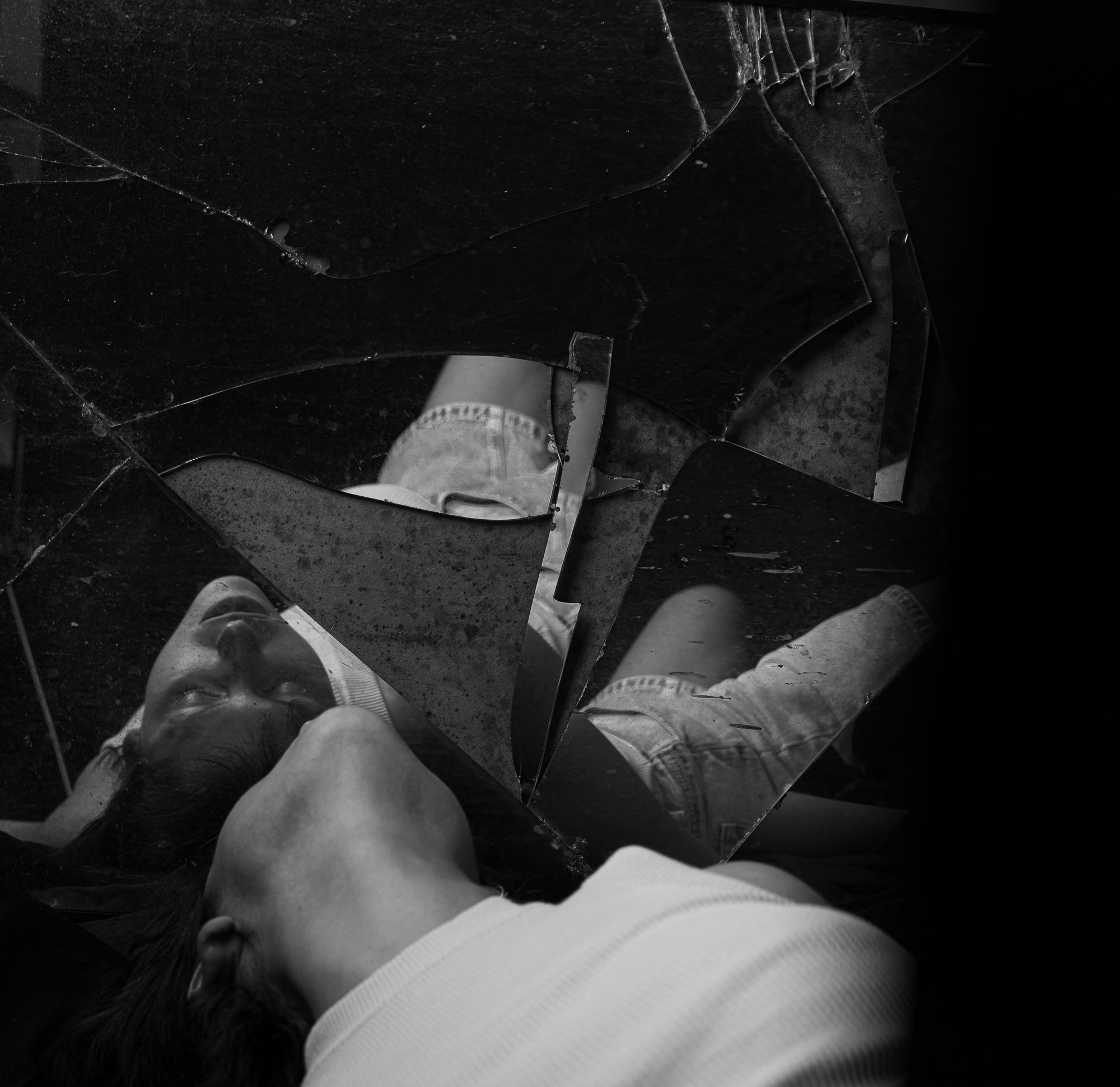
A photographic and mixed media project exploring fragmentation, reflection, and reassembly through queer embodiment, surrealist experimentation and altered image-making.
Conceptual framework
The Refraction Method explores identity as something that is not fixed, singular or fully knowable. In the work, the mirror does not simply reveal the self. It interrupts it. Reflections split the body, distort the face and create gaps between the person and their image. This creates a space where identity appears in fragments rather than as a complete or stable whole.
The project is interested in the image we are taught to believe in: the version of ourselves that appears in the mirror, in photographs, in other people’s expectations and in systems of beauty, gender and self-presentation. That image can feel fragile because it is often treated as something we must maintain. It is something we are expected to recognise, perform and protect.
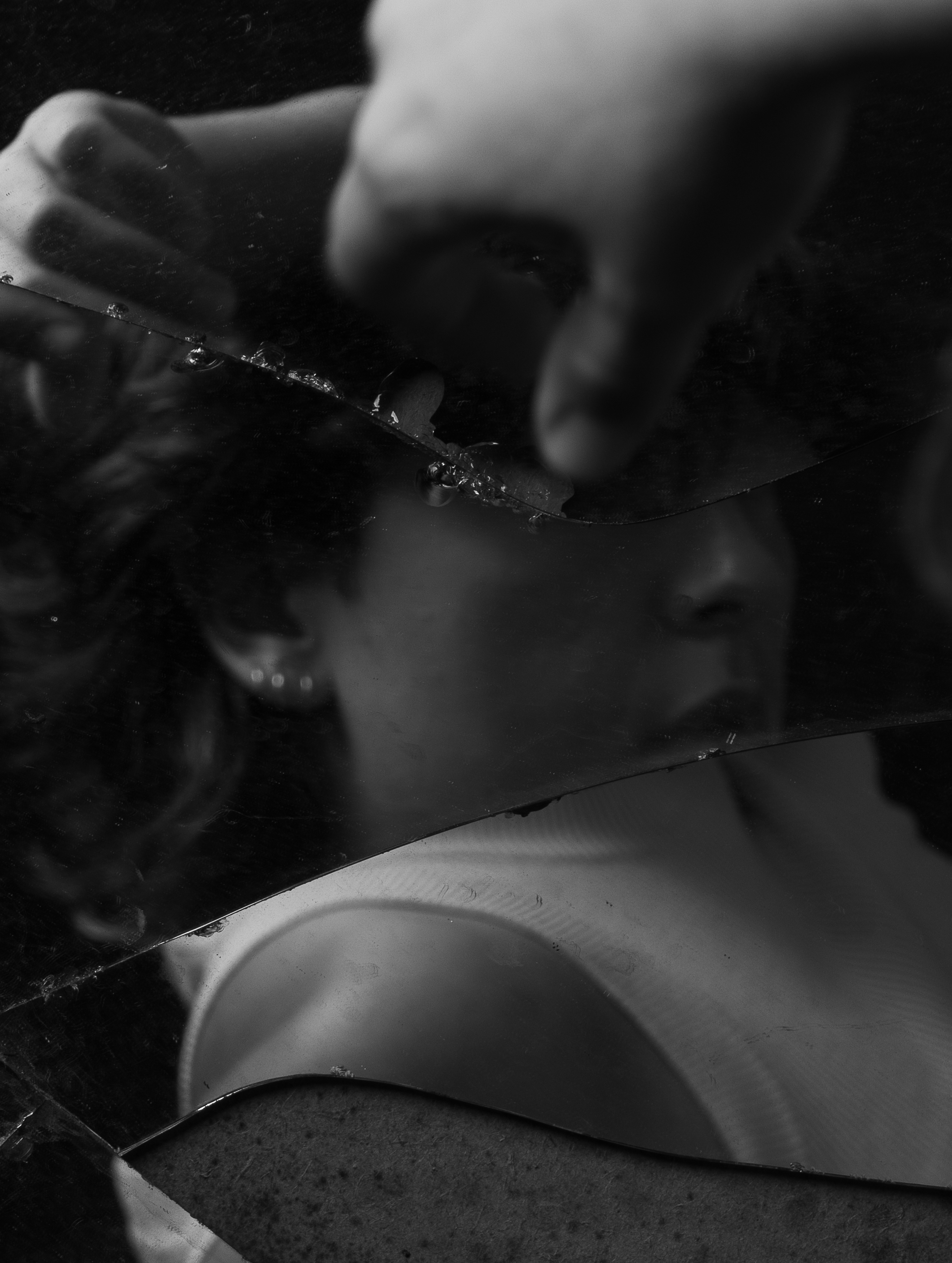
The mirror does not simply reveal the self. It interrupts it.
Mirrors, identity and the fragile self-image
Mirrors are often associated with truth, recognition and self-knowledge. They suggest that the image reflected back to us is a clear version of the self. The Refraction Method questions this idea.
A mirror can be intimate, but it can also be demanding. It is a place where we may search for ourselves, but also where we learn to judge, adjust and contain ourselves. The mirror does not only show an image. It can also teach us what image is expected.
In this project, the mirror becomes unreliable. It fragments, doubles, distorts and transforms the body. The reflected image does not offer a stable truth. Instead, it shows how identity can be shaped by angle, light, surface and perception.
The broken mirror is central to this process. A whole mirror gives the illusion of one complete image. A broken mirror reveals that the image was always dependent on the surface holding it. Once that surface cracks, the reflection becomes multiple. The self is still there, but it can no longer be contained in one version.
Through fracture and refraction, the work opens up a different way of thinking about identity. Rather than treating the self as something complete and easily represented, the project approaches identity as layered, shifting and always in relation to how it is seen.
Refraction as method
Refraction describes the bending of light as it passes through a surface. In this project, it also becomes a way of thinking about image-making.
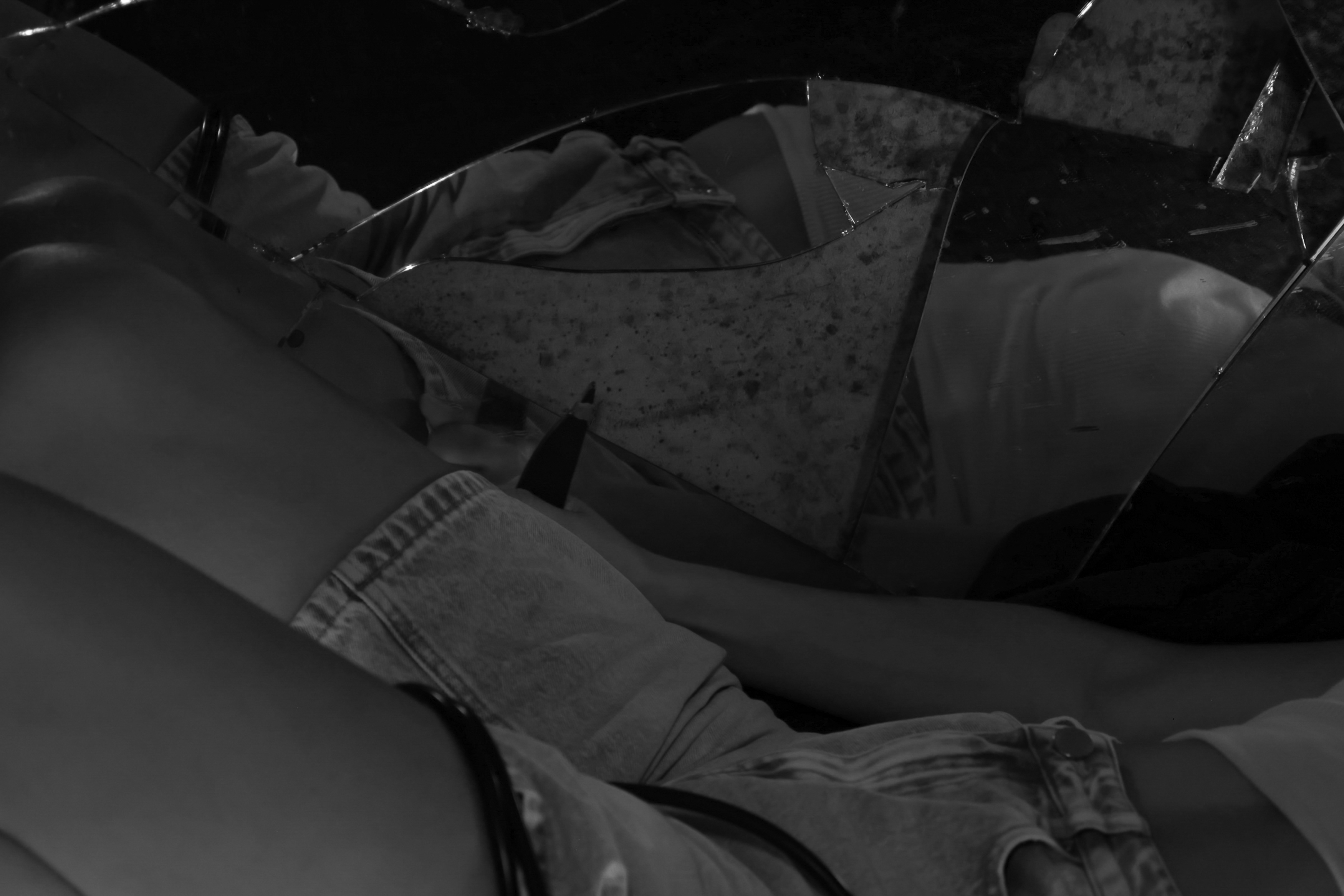
The work uses reflective and transparent materials to bend, interrupt or transform the photographic image. These visual disruptions create portraits that move between clarity and abstraction. The subject may be visible, but never fully contained by the image.
This method allows the photograph to become less like a document and more like an encounter. The image does not simply capture a person. It reveals the instability of looking itself.
The broken mirror extends this method further. It does not only bend the image. It breaks the expectation that the image should remain whole. It creates a new visual language from rupture, where each fragment holds a different angle, a different possibility, a different way of seeing.
In this sense, refraction becomes both a creative and conceptual process. It allows the work to explore how identity changes when seen through different surfaces, contexts and forms of perception.
Queer opacity and the reflected image
The Refraction Method connects to ideas of queer opacity: the right to remain layered, ambiguous or not fully explained.
The distorted or broken reflection resists the viewer’s desire for a clear or complete image. It does not offer the subject as something to be easily read, categorised or understood. Instead, the work allows the subject to remain partially hidden, multiplied or in motion.
This is especially important in relation to queer and femme identity, where visibility can be both powerful and complicated. Being seen can bring recognition, but it can also invite judgement or projection. The project holds this tension by creating images that are visible and obscured at the same time.
The broken mirror becomes a form of refusal. It does not disappear, but it does not fully submit to the gaze either. It breaks the idea that the subject must be seen clearly in order to be understood or valued.
In these images, opacity is not absence. It is presence on different terms. It creates space for identity to remain unstable, poetic and self-determined.
Fracture as possibility
But a broken mirror changes the rules of looking. It refuses one perfect reflection. It creates multiple versions at once. It asks whether the self might be more expansive than the image we have been given.
For queer and femme experiences, this has particular weight. Visibility can bring recognition and affirmation, but it can also involve projection, scrutiny and pressure to become readable. The Refraction Method uses the broken reflection to resist the idea that identity must be easily visible, beautiful, whole or explained.
In this project, fracture does not mean failure. It becomes a method of seeing differently. The broken image opens up new possibilities for the self: not as something ruined, but as something shifting, multiple and still becoming.
Research context
The Refraction Method sits within a broader tradition of artists and thinkers who use mirrors, reflection, fragmentation and distortion to question identity, representation and the image of the self.
Claude Cahun remains a central reference for the project. Their self-portraits used mirrors, masks, costumes and staged personas to resist fixed ideas of gender, identity and the body. Cahun’s work presents the self as something constructed, shifting and deliberately ambiguous, rather than stable or easily defined.
The project also connects to a wider history of women surrealist artists who used self-representation to challenge ideas of femininity, the body and female subjectivity. Artists such as Leonora Carrington, Dorothea Tanning, Frida Kahlo, Remedios Varo, Meret Oppenheim and Kay Sage used dream imagery, doubling, symbolic objects and strange interior worlds to unsettle conventional images of the self. The book Mirror Images: Women, Surrealism, and Self-Representation specifically places Cahun within this wider lineage of women artists using self-image to challenge how femininity is represented.
The mirror also has a strong place in feminist theory. Luce Irigaray’s Speculum of the Other Woman is a useful reference for this project because it critiques how women have historically been understood through systems of thought shaped by masculine perspectives. The idea of the “speculum” offers a different kind of mirror: not a flat surface that simply reflects back a fixed image, but a curved, disruptive and critical tool for questioning how femininity is seen and defined.
The project also resonates with Jacques Lacan’s mirror stage, where the mirror image becomes connected to the formation of the “I”. In this theory, the self is partly formed through recognising an image as oneself, but that recognition is also a kind of misrecognition. This is useful for The Refraction Method, because the broken mirror interrupts the idea that the reflected image is whole, truthful or complete.
From a queer perspective, the work connects to ideas of opacity: the right not to be fully readable, categorised or explained. Édouard Glissant’s idea of the “right to opacity” has been taken up in queer and visual theory as a way of resisting the demand for total visibility. This is especially relevant to artists working against surveillance, facial recognition and the pressure for identity to be easily legible.
Contemporary queer photographic practice also informs the project. Artists such as Åsa Johannesson use studio portraiture, classical references and photographic conventions to challenge how queer identity and desire are represented. Their work shows how photography can be used not simply to document identity, but to question the systems that make some bodies more readable, desirable or acceptable than others.
Other artists working with mirrors, reflection, the body and unstable self-image also form part of this visual context. Francesca Woodman used blur, partial concealment and the body dissolving into space to create images where the figure feels present but unstable. Ana Mendieta used the body, trace and absence to explore identity, ritual and transformation. Mona Hatoum has used bodily and domestic materials to make familiar objects feel strange, unstable or threatening. Yayoi Kusama’s mirror works create infinite repetition and dissolution of the self, turning reflection into an immersive experience of multiplication.
Within this context, The Refraction Method uses the broken mirror as both material and metaphor. The mirror is not simply a tool for reflection. It becomes a site of rupture, where the image we are told to recognise as ourselves begins to crack. Through mirrors, fractured surfaces and altered photographic processes, the project asks whether breaking the image might reveal something more expansive, complex and beautiful than the unbroken reflection ever could.